Thursday, February 21, 2019

The Influence of Voice Search on Featured Snippets

Posted by TheMozTeam

This post was originally published on the STAT blog.

We all know that featured snippets provide easy-to-read, authoritative answers and that digital assistants love to say them out loud when asked questions.

This means that featured snippets have an impact on voice search — bad snippets, or no snippets at all, and digital assistants struggle. By that logic: Create a lot of awesome snippets and win the voice search race. Right?

Right, but there’s actually a far more interesting angle to examine — one that will help you nab more snippets and optimize for voice search at the same time. In order to explore this, we need to make like Doctor Who and go back in time.

From typing to talking

Back when dinosaurs roamed the earth and queries were typed into search engines via keyboards, people adapted to search engines by adjusting how they performed queries. We pulled out unnecessary words and phrases, like “the,” “of,” and, well, “and,” which created truncated requests — robotic-sounding searches for a robotic search engine.

The first ever dinosaur to use Google.

From this, we may be inclined to format all of our “best” and “how to” keyword content into lists. But, as you can see in the chart above, paragraphs and tables are still appearing here, and we could be leaving snippets on the table by ignoring them. If we have time, we’ll dig into which keywords those formats are a better fit for and why.

Get tracking

You could be the Wonder Woman of meta descriptions, but if you aren’t optimizing for the right kind of snippets, then your content’s going to have a harder time getting heard. Building out a voice search-friendly keyword list to track is the first step to lassoing those snippets.

Want to learn how you can do that in STAT? Say hello and request a tailored demo.

Need more snippets in your life? We dug into Google’s double-snippet SERPs for you — double the snippets, double the fun.


Sign up for The Moz Top 10, a semimonthly mailer updating you on the top ten hottest pieces of SEO news, tips, and rad links uncovered by the Moz team. Think of it as your exclusive digest of stuff you don't have time to hunt down but want to read!

What’s New for 2019 in Social Media Lead Generation

What's New in Social Media Lead Generation

Leads and sales are the lifeblood of your business. How can you get more leads? By using social media lead generation. Learn what's new in lead generation.

READ MORE >>

The post What’s New for 2019 in Social Media Lead Generation authored by Mike Gingerich appeared first on Neal Schaffer-Social Media Speaker, Author, Consultant, Educator and Influencer.

SEO Channel Context: An Analysis of Growth Opportunities

Posted by BrankoK

Too often do you see SEO analyses and decisions being made without considering the context of the marketing channel mix. Equally as often do you see large budgets being poured into paid ads in ways that seem to forget there's a whole lot to gain from catering to popular search demand.

Both instances can lead to leaky conversion funnels and missed opportunity for long term traffic flows. But this article will show you a case of an SEO context analysis we used to determine the importance and role of SEO.

This analysis was one of our deliverables for a marketing agency client who hired us to inform SEO decisions which we then turned into a report template for you to get inspired by and duplicate.

Case description

The included charts show real, live data. You can see the whole SEO channel context analysis in this Data Studio SEO report template.

The traffic analyzed is for of a monetizing blog, whose marketing team also happens to be one of most fun to work for. For the sake of this case study, we're giving them a spectacular undercover name — "The Broze Fellaz."

For context, this blog started off with content for the first two years before they launched their flagship product. Now, they sell a catalogue of products highly relevant to their content and, thanks to one of the most entertaining Shark Tank episodes ever aired, they have acquired investments and a highly engaged niche community.

As you’ll see below, organic search is their biggest channel in many ways. Facebook also runs both as organic and paid and the team spends many an hour inside the platform. Email has elaborate automated flows that strive to leverage subscribers that come from the stellar content on the website. We therefore chose the three — organic Search, Facebook, and email — as a combination that would yield a comprehensive analysis with insights we can easily act on.

Ingredients for the SEO analysis

This analysis is a result of a long-term retainer relationship with "The Broze Fellaz" as our ongoing analytics client. A great deal was required in order for data-driven action to happen, but we assure you, it's all doable.

From the analysis best practice drawer, we used:

  • 2 cups of relevant channels for context and analysis via comparison.
  • 3 cups of different touch points to identify channel roles — bringing in traffic, generating opt-ins, closing sales, etc.
  • 5 heads of open-minded lettuce and readiness to change current status quo, for a team that can execute.
  • 457 oz of focus-on-finding what is going on with organic search, why it is going on, and what we can do about it (otherwise, we’d end up with another scorecard export).
  • Imperial units used in arbitrary numbers that are hard to imagine and thus feel very large.
  • 1 to 2 heads of your analyst brain, baked into the analysis. You're not making an automated report — even a HubSpot intern can do that. You're being a human and you're analyzing. You're making human analysis. This helps avoid having your job stolen by a robot.
  • Full tray of Data Studio visualizations that appeal to the eye.
  • Sprinkles of benchmarks, for highlighting significance of performance differences.

From the measurement setup and stack toolbox, we used:

  • Google Analytics with tailored channel definitions, enhanced e-commerce and Search Console integration.
  • Event tracking for opt-ins and adjusted bounce rate via MashMetrics GTM setup framework.
  • UTM routine for social and email traffic implemented via Google Sheets & UTM.io.
  • Google Data Studio. This is my favorite visualization tool. Despite its flaws and gaps (as it’s still in beta) I say it is better than its paid counterparts, and it keeps getting better. For data sources, we used the native connectors for Google Analytics and Google Sheets, then Facebook community connectors by Supermetrics.
  • Keyword Hero. Thanks to semantic algorithms and data aggregation, you are indeed able to see 95 percent of your organic search queries (check out Onpage Hero, too, you'll be amazed).

Inspiration for my approach comes from Lea Pica, Avinash, the Google Data Studio newsletter, and Chris Penn, along with our dear clients and the questions they have us answer for them.

Ready? Let's dive in.

Analysis of the client's SEO on the context of their channel mix1) Insight: Before the visit

What's going on and why is it happening?

Organic search traffic volume blows the other channels out of the water. This is normal for sites with quality regular content; yet, the difference is stark considering the active effort that goes into Facebook and email campaigns.

The CTR of organic search is up to par with Facebook. That's a lot to say when comparing an organic channel to a channel with high level of targeting control.

It looks like email flows are the clear winner in terms of CTR to the website, which has a highly engaged community of users who return fairly often and advocate passionately. It also has a product and content that's incredibly relevant to their users, which few other companies appear to be good at.

There's a high CTR on search engine results pages often indicates that organic search may support funnel stages beyond just the top.

As well, email flows are sent to a very warm audience — interested users who went through a double opt-in. It is to be expected for this CTR to be high.

What's been done already?

There's an active effort and budget allocation being put towards Facebook Ads and email automation. A content plan has been put in place and is being executed diligently.

What we recommend next
  1. Approach SEO in a way as systematic as what you do for Facebook and email flows.
  2. Optimize meta titles and descriptions via testing tools such as Sanity Check. The organic search CTR may become consistently higher than that of Facebook ads.
  3. Assuming you've worked on improving CTR for Facebook ads, have the same person work on the meta text and titles. Most likely, there'll be patterns you can replicate from social to SEO.
  4. Run a technical audit and optimize accordingly. Knowing that you haven’t done that in a long time, and seeing how much traffic you get anyway, there’ll be quick, big wins to enjoy.
Results we expect

You can easily increase the organic CTR by at least 5 percent. You could also clean up the technical state of your site in the eyes of crawlers -— you’ll then see faster indexing by search engines when you publish new content, increased impressions for existing content. As a result, you may enjoy a major spike within a month.

2) Insight: Engagement and options during the visit

With over 70 percent of traffic coming to this website from organic search, the metrics in this analysis will be heavily skewed towards organic search. So, comparing the rate for organic search to site-wide is sometimes conclusive, other times not conclusive.

Adjusted bounce rate — via GTM events in the measurement framework used, we do not count a visit as a bounce if the visit lasts 45 seconds or longer. We prefer this approach because such an adjusted bounce rate is much more actionable for content sites. Users who find what they were searching for often read the page they land on for several minutes without clicking to another page. However, this is still a memorable visit for the user. Further, staying on the landing page for a while, or keeping the page open in a browser tab, are both good indicators for distinguishing quality, interested traffic, from all traffic.

We included all Facebook traffic here, not just paid. We know from the client’s data that the majority is from paid content, they have a solid UTM routine in place. But due to boosted posts, we’ve experienced big inaccuracies when splitting paid and organic Facebook for the purposes of channel attribution.

What's going on and why is it happening?

It looks like organic search has a bounce rate worse than the email flows — that's to be expected and not actionable, considering that the emails are only sent to recent visitors who have gone through a double opt-in. What is meaningful, however, is that organic has a better bounce rate than Facebook. It is safe to say that organic search visitors will be more likely to remember the website than the Facebook visitors.

Opt-in rates for Facebook are right above site average, and those for organic search are right below, while organic is bringing in a majority of email opt-ins despite its lower opt-in rate.

Google's algorithms and the draw of the content on this website are doing better at winning users' attention than the detailed targeting applied on Facebook. The organic traffic will have a higher likelihood of remembering the website and coming back. Across all of our clients, we find that organic search can be a great retargeting channel, particularly if you consider that the site will come up higher in search results for its recent visitors.

What's been done already?

The Facebook ad campaigns of "The Broze Fellaz" have been built and optimized for driving content opt-ins. Site content that ranks in organic search is less intentional than that.

Opt-in placements have been tested on some of the biggest organic traffic magnets.

Thorough, creative and consistent content calendars have been in place as a foundation for all channels.

What we recommend next
  1. It's great to keep using organic search as a way to introduce new users to the site. Now, you can try to be more intentional about using it for driving opt-ins. It’s already serving both of the stages of the funnel.
  2. Test and optimize opt-in placements on more traffic magnets.
  3. Test and optimize opt-in copy for top 10 traffic magnets.
  4. Once your opt-in rates have improved, focus on growing the channel. Add to the content work with a 3-month sprint of an extensive SEO project
  5. Assign Google Analytics goal values to non-e-commerce actions on your site. The current opt-ins have different roles and levels of importance and there’s also a handful of other actions people can take that lead to marketing results down the road. Analyzing goal values will help you create better flows toward pre-purchase actions.
  6. Facebook campaigns seem to be at a point where you can pour more budget into them and expect proportionate increase in opt-in count.
Results we expect

Growth in your opt-ins from Facebook should be proportionate to increase in budget, with a near-immediate effect. At the same time, it’s fairly realistic to bring the opt-in rate of organic search closer to site average.

3) Insight: Closing the deal

For channel attribution with money involved, you want to make sure that your Google Analytics channel definitions, view filters, and UTM’s are in top shape.

What's going on and why is it happening?

Transaction rate, as well as per session value, is higher for organic search than it is for Facebook (paid and organic combined).

Organic search contributes to far more last-click revenue than Facebook and email combined. For its relatively low volume of traffic, email flows are outstanding in the volume of revenue they bring in.

Thanks to the integration of Keyword Hero with Google Analytics for this client, we can see that about 30 percent of organic search visits are from branded keywords, which tends to drive the transaction rate up.

So, why is this happening? Most of the product on the site is highly relevant to the information people search for on Google.

Multi-channel reports in Google Analytics also show that people often discover the site in organic search, then come back by typing in the URL or clicking a bookmark. That makes organic a source of conversions where, very often, no other channels are even needed.

We can conclude that Facebook posts and campaigns of this client are built to drive content opt-ins, not e-commerce transactions. Email flows are built specifically to close sales.

What’s been done already?

There is dedicated staff for Facebook campaigns and posts, as well a thorough system dedicated to automated email flows.

A consistent content routine is in place, with experienced staff at the helm. A piece has been published every week for the last few years, with the content calendar filled with ready-to-publish content for the next few months. The community is highly engaged, reading times are high, comment count soaring, and usefulness of content outstanding. This, along with partnerships with influencers, helps "The Broze Fellaz" take up a half of the first page on the SERP for several lucrative topics. They’ve been achieving this even without a comprehensive SEO project. Content seems to be king indeed.

Google Shopping has been tried. The campaign looked promising but didn't yield incremental sales. There’s much more search demand for informational queries than there is for product.

What we recommend next
  1. Organic traffic is ready to grow. If there is no budget left, resource allocation should be considered. In paid search, you can often simply increase budgets. Here, with stellar content already performing well, a comprehensive SEO project is begging for your attention. Focus can be put into structure and technical aspects, as well as content that better caters to search demand. Think optimizing the site’s information architecture, interlinking content for cornerstone structure, log analysis, and technical cleanup, meta text testing for CTR gains that would also lead to ranking gains, strategic ranking of long tail topics, intentional growing of the backlink profile.
  2. Three- or six-month intensive sprint of comprehensive SEO work would be appropriate.
Results we expect

Increasing last click revenue from organic search and direct by 25 percent would lead to a gain as high as all of the current revenue from automated email flows. Considering how large the growth has been already, this gain is more than achievable in 3–6 months.

Wrapping it up

Organic search presence of "The Broze Fellaz" should continue to be the number-one role for bringing new people to the site and bringing people back to the site. Doing so supports sales that happen with the contribution of other channels, e.g. email flows. The analysis points out is that organic search is also effective at playing the role of the last-click channel for transactions, often times without the help of other channels.

We’ve worked with this client for a few years, and, based on our knowledge of their marketing focus, this analysis points us to a confident conclusion that a dedicated, comprehensive SEO project will lead to high incremental growth.

Your turn

In drawing analytical conclusions and acting on them, there’s always more than one way to shoe a horse. Let us know what conclusions you would’ve drawn instead. Copy the layout of our SEO Channel Context Comparison analysis template and show us what it helped you do for your SEO efforts — create a similar analysis for a paid or owned channel in your mix. Whether it’s comments below, tweeting our way, or sending a smoke signal, we’ll be all ears. And eyes.


Sign up for The Moz Top 10, a semimonthly mailer updating you on the top ten hottest pieces of SEO news, tips, and rad links uncovered by the Moz team. Think of it as your exclusive digest of stuff you don't have time to hunt down but want to read!

Wednesday, February 20, 2019

Make sense of your data with these essential keyword segments

Posted by TheMozTeam

This blog post was originally published on the STAT blog.

The first step to getting the most out of your SERP data is smart keyword segmentation — it surfaces targeted insights that will help you make data-driven decisions.

But knowing what to segment can feel daunting, especially when you’re working with thousands of keywords. That’s why we’re arming you with a handful of must-have tags.

Follow along as we walk through the different kinds of segments in STAT, how to create them, and which tags you’ll want to get started with. You’ll be a fanciful segment connoisseur by the time we’re through!

Segmentation in STAT

In STAT, keyword segments are called “tags” and come as two different types: standard or dynamic.

Standard tags are best used when you want to keep specific keywords grouped together because of shared characteristics — like term (brand, product type, etc), location, or device. Standard tags are static, so the keywords that populate those segments won’t change unless you manually add or remove them.

Dynamic tags, on the other hand, are a fancier kind of tag based on filter criteria. Just like a smart playlist, dynamic tags automatically populate with all of the keywords that meet said criteria, such as keywords with a search volume over 500 that rank on page one. This means that the keywords in a dynamic tag aren’t forever — they’ll filter in and out depending on the criteria you’ve set.

How to create a keyword segment

Tags are created in a few easy steps. At the Site level, pop over to the Keywords tab, click the down arrow on any table column header, and then select Filter keywords. From there, you can select the pre-populated options or enter your own metrics for a choose-your-own-filter adventure.

Once your filters are in place, simply click Tag All Filtered Keywords, enter a new tag name, and then pick the tag type best suited to your needs — standard or dynamic — and voila! You’ve created your very own segment.

Segments to get you started

Now that you know how to set up a tag, it’s time to explore some of the different segments you can implement and the filter criteria you’ll need to apply.

Rank and rank movement

Tracking your rank and ranking movements with dynamic tags will give you eyeballs on your keyword performance, making it easy to monitor and report on current and historical trends.

There’s a boatload of rank segments you can set up, but here’s just a sampling to get you started:

  • Keywords ranking in position 1–3; this will identify your top performing keywords.
  • Keywords ranking in position 11–15; this will suss out the low-hanging, top of page two fruit in need of a little nudge.
  • Keywords with a rank change of 10 or more (in either direction); this will show you keywords that are slipping off or shooting up the SERP.

Appearance and ownership of SERP features

Whether they’re images, carousels, or news results, SERP features have significantly altered the search landscape. Sometimes they push you down the page and other times, like when you manage to snag one, they can give you a serious leg up on the competition and drive loads more traffic to your site.

Whatever industry-related SERP features that you want to keep apprised of, you can create dynamic tags that show you the prevalence and movement of them within your keyword set. Segment even further for tags that show which keywords own those features and which have fallen short.

Below are a few segments you can set up for featured snippets and local packs.

Featured snippets

Everyone’s favourite SERP feature isn’t going anywhere anytime soon, so it wouldn’t be a bad idea to outfit yourself with a snippet tracking strategy. You can create as many tags as there are snippet options to choose from:

  • Keywords with a featured snippet.
  • Keywords with a paragraph, list, table, and/or carousel snippet.
  • Keywords with an owned paragraph, list, table, and/or carousel snippet.
  • Keywords with an unowned paragraph, list, table, and/or carousel snippet.

The first two will allow you to see over-arching snippet trends, while the last two will chart your ownership progress.

If you want to know the URL that’s won you a snippet, just take a peek at the URL column.

Local packs

If you’re a brick and mortar business, we highly advise creating tags for local packs since they provide a huge opportunity for exposure. These two tags will show you which local packs you have a presence in and which you need to work on

  • Keywords with an owned local pack.
  • Keywords with an unowned local pack.

Want all the juicy data squeezed into a local pack, like who’s showing up and with what URL? We created the Local pack report just for that.

Landing pages, subdomains, and other important URLs

Whether you’re adding new content or implementing link-building strategies around subdomains and landing pages, dynamic tags allow you to track and measure page performance, see whether your searchers are ending up on the pages you want, and match increases in page traffic with specific keywords.

For example, are your informational intent keywords driving traffic to your product pages instead of your blog? To check, a tag that includes your blog URL will pull in each post that ranks for one of your keywords.

Try these three dynamic tags for starters:

  • Keywords ranking for a landing page URL.
  • Keywords ranking for a subdomain URL.
  • Keywords ranking for a blog URL.

Is a page not indexed yet? That’s okay. You can still create a dynamic tag for its URL and keywords will start appearing in that segment when Google finally gets to it.

Location, location, location

Google cares a lot about location and so should you, which is why keyword segments centred around location are essential. You can tag in two ways: by geo-modifier and by geo-location.

For these, it’s better to go with the standard tag as the search term and location are fixed to the keyword.

Geo-modifier

A geo-modifier is the geographical qualifier that searchers manually include in their query — like in [sushi near me]. We advocate for adding various geo-modifiers to your keywords and then incorporating them into your tagging strategy. For instance, you can segment by:

  • Keywords with “in [city]” in them.
  • Keywords with “near me” in them.

The former will show you how you fare for city-wide searches, while the latter will let you see if you’re meeting the needs of searchers looking for nearby options.

Geo-location

Geo-location is where the keyword is being tracked. More tracked locations mean more searchers’ SERPs to sample. And the closer you can get to searchers standing on a street corner, the more accurate those SERPs will be. This is why we strongly recommend you track in multiple pin-point locations in every market you serve.

Once you’ve got your tracking strategy in place, get your segmentation on. You can filter and tag by:

  • Keywords tracked in specific locations; this will let you keep tabs on geographical trends.
  • Keywords tracked in each market; this will allow for market-level research.

Search volume & cost-per-click

Search volume might be a contentious metric thanks to Google’s close variants, but having a decent idea of what it’s up to is better than a complete shot in the dark. We suggest at least two dynamic segments around search volume:

  • Keywords with high search volume; this will show which queries are popular in your industry and have the potential to drive the most traffic.
  • Keywords with low search volume; this can actually help reveal conversion opportunities — remember, long-tail keywords typically have lower search volumes but higher conversion rates.

Tracking the cost-per-click of your keywords will also bring you and your PPC team tonnes of valuable insights — you’ll know if you’re holding the top organic spot for an outrageously high CPC keyword.

As with search volume, tags for high and low CPC should do you just fine. High CPC keywords will show you where the competition is the fiercest, while low CPC keywords will surface your easiest point of entry into the paid game — queries you can optimize for with less of a fight.

Device type

From screen size to indexing, desktop and smartphones produce substantially different SERPs from one another, making it essential to track them separately. So, filter and tag for:

  • Keywords tracked on a desktop.
  • Keywords tracked on a smartphone.

Similar to your location segments, it’s best to use the standard tag here.

Go crazy with multiple filters

We’ve shown you some really high-level segments, but you can actually filter down your keywords even further. In other words, you can get extra fancy and add multiple filters to a single tag. Go as far as high search volume, branded keywords triggering paragraph featured snippets that you own for smartphone searchers in the downtown core. Phew!

Want to make talk shop about segmentation or see dynamic tags in action? Say hello (don’t be shy) and request a demo.


Sign up for The Moz Top 10, a semimonthly mailer updating you on the top ten hottest pieces of SEO news, tips, and rad links uncovered by the Moz team. Think of it as your exclusive digest of stuff you don't have time to hunt down but want to read!

6 Digital Marketing Trends for 2019 and How to Adopt Them

6 Digital Marketing Trends for 2019 and How to Adopt Them

While the way that businesses have used marketing campaigns over the years has changed, the reasons have not. Every business wants to reach their ideal customer just when that customer needs it.

With the constant flux of new technologies, the way that companies need to reach these customers has to evolve to make up the difference.

Here are a few tips to help pull your business marketing into the new year and get you more business.

Digital Marketing Trend #1: Omnichannel Marketing

Today’s consumer uses multiple channels to research, compare, buy from and interact with businesses. These can be both online and offline channels, and the latter include your own website as well as Amazon, eBay, Facebook, etc.

Connecting the dots between multiple channels ensuring consistent user experience and encouraging the consumer to engage with your brand at every touchpoint across multiple channels is called omnichannel marketing.

The newest research study by BigCommerce offers a detailed look into how different generations of consumers approach omnichannel shopping as well as what they expect from brands throughout their buyer’s journey.

The takeaways from the study are very interesting:

  • These days nobody shops exclusively through a single medium
  • Younger generations use all kinds of media to purchase products, but they also know no other way to shop
  • Younger generations shop in physical stores considerably less (Only 9.6% of Gen Z reports buying items in a physical store), they are more likely to return products and they value speed and ease of shopping experience

With omnichannel presence becoming an expected shopping experience, ensure your product placement everywhere you can. It’s not just about outright selling: Being everywhere means brand recognizability which is another solid way to increase your ROI in the long run. The most obvious channel your brand needs to be include:

  • Facebook and Instagram (including Facebook+Instagram ads)
  • Amazon (Remember: Amazon is also a search and product discovery channel, so you need to be in its algorithm)
  • Google’s Shopping Actions: Google’s multi-channel platform that ensures your buyer’s consistent experience whichever medium they use to search. For example, they can search by voice, use voice commands to add products to cart and make the final purchase from the desktop.

Apart from that, creating consistent brand presence across multiple platforms is an effective way to build familiarity with the brand and engage customers across many channels more consistently. ContentCal is a solid tool that can help you accomplish just that in a more productive less cost-effective way.

ContentCal allows to cross-post your social media updates across multiple channels as well as set up multi-step delegation and moderation process: Encourage your whole team to add unique social media updates to CantentCal’s “Pinboard” and have one (or more) moderator who will ensure the updates align with the brand’s voice and then easily schedule them via drag-and-dropping functionality.

Digital Marketing Trend #2: Artificial Intelligence and Machine Learning

Artificial Intelligence (AI) is the branch in computer science that is all about teaching the machine to think and act like a human being.

Machine learning is usually what runs behind AI algorithms. While AI is all about basically teaching the machine to replace human beings, machine learning is about teaching the machine what a human brains cannot grasp, e.g. complex data mining and future predictions based on current patterns.

In many cases, machine learning and AI are the two terms that are used interchangeably.

To make it easier to fathom, here are a few examples of AI-driven technology we already witness in our digital lives:

  • Gmail Smart Compose and Smart Reply features allow the user to compose an entire email with AI based on past emails and typing habits.
  • LinkedIn prompts value-added introductions based on who you interacted in the past.
  • Facebook Messenger sends auto-responses to your Facebook followers on your brand’s behalf.

The two well-known pioneers in the AI-empowered marketing are:

  • Amazon: Using AI to analyze each particular buyer’s decisions and suggest them products they didn’t even know they want or need.
  • Netflix: Using AI for content recommendations and beyond. Netflix successfully applies AI for product development too. They have analyzed years of viewer data to create successful products of their own including the successful “House of Cards” show. Put simply, thanks to AI, Netflix knows what people want before they do.

With each new generation, consumers tend to rely on AI-powered algorithms for product discovery more and more. BigCommerce has found that consumers in the age range between 18 and 23 heavily rely on AI-powered personalized product recommendations, seeing ads on social media, and engaging with a brand’s social channels.

One of the best ways to take advantage of machine learning right now is to pick a solid technology partner that already has the technology built in and running in the background.

AI-powered sentiment analysis is the most powerful example of machine learning in action. Today’s sentiment analysis software can not only extract mentions that need your attention but also help your teams handle them properly.

Sentione is a solid example of this forward-thinking sentiment analysis approach. It implements machine learning and natural language mechanisms to extract online context around your brand. Next, Sentione’s AI-powered self-learning agent suggests further action based on the collected data and previous communications with clients:

[Sentione’s AI-powered platform is the future of online interaction with the client]

Digital Marketing Trend #3: Voice Search

The emergence and fast adoption of digital home assistants, like the Amazon Echo, the Google Dot, and Apple’s Homepod, is causing the new searching behavior, i.e. voice search(also known as conversational search).

These smart devices make searching far easier and entirely hands-free. “Alexa, when is the next movie time for The Avengers?” It’s that easy.

With nearly 40% of adults using voice search a day back in 2016, this technology adoption is quickly increasing over time as it becomes more intuitive and reliable. Domino’s has taken the lead, incorporating voice search as a way to increase sales.

With voice and on-the-go searching ability, online search queries have become longer and more specific. But in reality targeting long-tail queries is only the tip of the iceberg. Google had been preparing its algorithm for natural-language searching for ages now. After its Hummingbird update and Rankbrain announcement, we have seen just a few hints at what Google is working on.

Thanks to machine learning, Google understands intent and context much better now than it used to which means keyword matching useless. These days keyword research is a more complicated process. There are a few smart tools already on the market offering a much more sophisticated approach to keyword research. The two tools I mentioned previously are:

TextOptimizer allows you to optimize content to match Google’s (and its users’) expectations (i.e. intent) by analyzing search snippets for each query and suggesting the related terms, concepts and categories.

[TextOptimizer has a web-based version as well as Google Chrome extension and WordPress plugin]

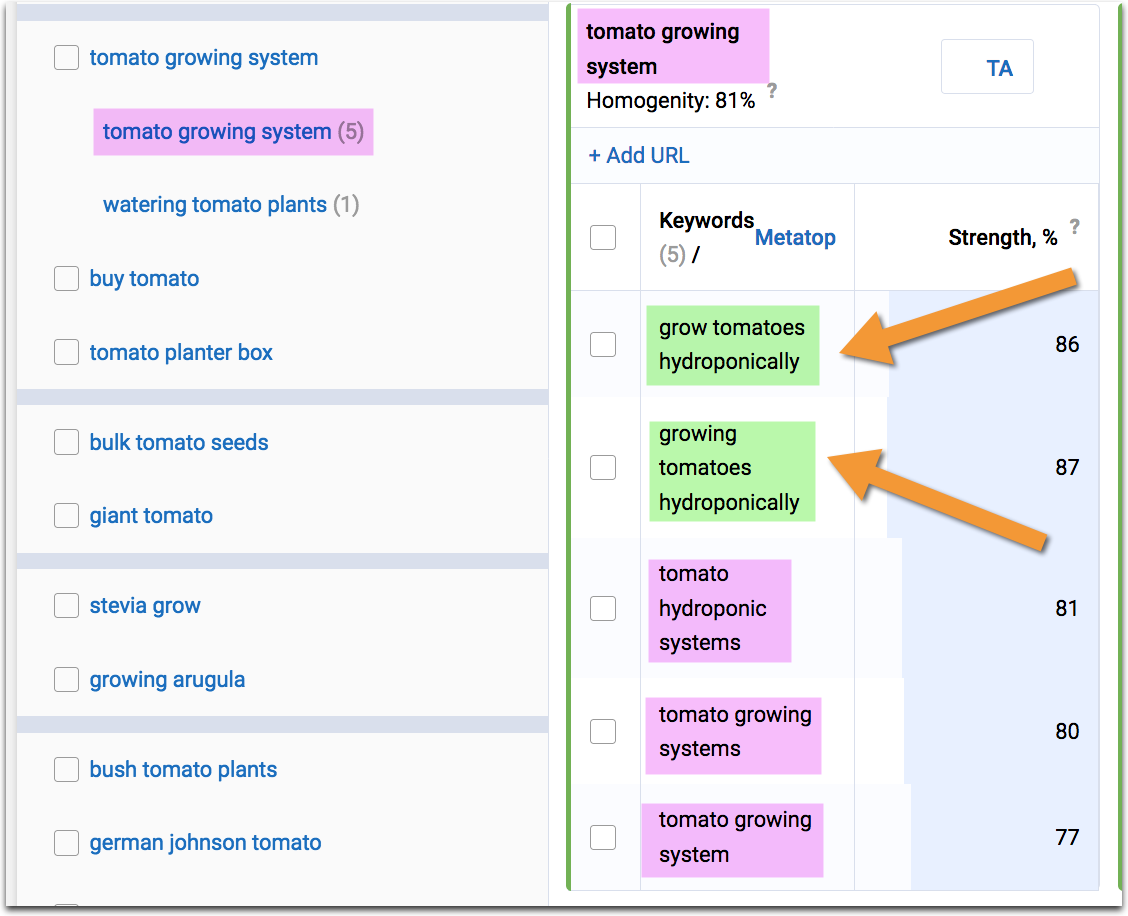
Serpstat analyzes Google’s search engine result pages, finds overlapping URLs and groups your keyword lists by relevancy allowing you to discover concepts behind your queries and optimizing for the group of related keywords:

Serpstat keyword clustering

[Read more about keyword clustering here]

Both the suites represent the new generation of SEO software allowing you to analyze and optimize beyond keyword matching, to better optimize your content and to prepare for any kind of search behavior (be it typed words or voice commands).

Digital Marketing Trend #4: Personalized Marketing

Personalized marketing means providing individualized user experience targeting each separate user of your site or subscriber to your email list.

According to Evergage, nearly 96% of consumers agree that personalized marketing fosters relationship building with the brand. Forrester has found that almost 80% of consumers have recommended, or paid more for a product thanks to a personalized service or experience.

Despite what you may have heard, increasing security and privacy concerns are not going to kill personalized marketing. Today’s consumer expects to receive personalized experience and is ready to give away their personal data in return.

BigCommerce has found that younger generations of consumers don’t mind sharing their personal data in return for perks and personalized experience:

Sites like Netflix, Amazon, and Pinterest, not to mention Google and Facebook, all use personalized marketing campaigns. They mine your search history, what you liked and didn’t like, and provide recommendations for similar products you didn’t even intend to buy.

Digital Marketing Trend #5: Video Marketing and Influencer Marketing

While YouTube is what many people think of first, video marketing can be utilized across social media platforms, like Facebook, LinkedIn, and Instagram stories and Snapchat.

If your videos are short, concise, and entertaining, people will be more likely to share them on other social media sites.

This can have a more substantial impact if an influencer is well-known on the platform, and can put their hat into the ring. These leaders of the industries can help spread the word for your products or content quickly.

Know your target audience, find where they are, and get to work. For more details and tips on various influencer marketing tactics, check out these resources:

Digital Marketing Trend #6: Visual Search

With the increased availability of smartphones and on-the-go access to the Internet, the searching capabilities are evolving.

While voice search eliminates the need for typing your keywords in a search box and even the screen to interact with the results, visual search transforms the concept of the keyword itself. You don’t need words: You can search by showing the picture.

Apps like Google Lens make it possible to use your camera as a search tool. Landmarks, clothes, art, books, business cards can all be searched through a single image. Product prices, reviews, and retailers can be found through a picture of a book or a picture of clothing.

The best ways to make the most of visual search are:

Conclusion

In 2019, the way consumers search for information and shop has evolved to include AI-powered personalization, advanced segmentation and new content types, slowly incorporating more of these new technologies.

These new technological advances have amazing potential within the marketing sector if you know how to use them to your advantage. With so many other businesses you are competing against across your industry, the faster you learn how to utilize new techniques (including voice and visual search as well as personalization and influencer marketing), the more competitive your business becomes.

For video and personalized marketing, revisiting your current strategy and altering it to fit the needs of your audience is essential. Whatever technique you decide to use moving forward, keep yourself informed of new advances to keep your business ahead of the game.

The post 6 Digital Marketing Trends for 2019 and How to Adopt Them appeared first on Convince and Convert: Social Media Consulting and Content Marketing Consulting.

Tuesday, February 19, 2019

The (Social Media) Marketing Trends You Need to Understand Today – Podcast Ep. 136

The Social Media Marketing Trends You Need to Understand Today

Social media keeps changing – and that’s exactly why it is a constant fight to keep up with latest social media marketing trends. It seems that every few weeks you hear that Facebook has some new algorithm that messes up all the energy you’ve been putting into it. Then a new feature appears and everyone tells...

Read More »

The post The (Social Media) Marketing Trends You Need to Understand Today – Podcast Ep. 136 authored by Neal Schaffer appeared first on Neal Schaffer-Social Media Speaker, Author, Consultant, Educator and Influencer.

What Would You Do If Your Contest Went Viral?

Your Creative Social Media Contest Went Viral. Now What?

If your creative social media contest gets larger than you've anticipated what do you do? Learn and address any issues before you have them.

READ MORE >>

The post What Would You Do If Your Contest Went Viral? authored by Carolyn Wilman appeared first on Neal Schaffer-Social Media Speaker, Author, Consultant, Educator and Influencer.