Wednesday, September 19, 2018

How to Improve Your Link Building Outreach Pipeline

Posted by John.Michael123

Link building is probably one of the most challenging pieces of your SEO efforts. Add multiple clients to the mix, and managing the link outreach process gets even tricker. When you’re in the thick of several outreach campaigns, it’s hard to know where to focus your efforts and which tactics will bring you the most return on your time and resources.

Three common questions are critical to understand at any point in your link campaign:

  • Do you need more link prospects?
  • Do you need to revise your email templates?
  • Do you need to follow up with prospects?

Without a proven way to analyze these questions, your link building efforts won’t be as efficient as they could be.

We put together a Google Sheets template to help you better manage your link building campaigns. The beauty of this template is that it allows for customization to better fit your workflow. You'll want to make a copy to get started with your own version.

Our link building workflow

We've been able to improve our efficiency via this template by following a simple workflow around acquiring new guest posts on industry-relevant websites. The first step is to actually go out and find prospects that could be potentially interested in a guest blog post. We will then record those opportunities into our template so that we can track our efforts and identify any area that isn’t performing well.

The next step is to make sure to update the status of the prospect when anything changes like sending an outreach email to the prospect or getting a reply from them. It’s critical to keep the spreadsheet as up to date as possible so that we have an accurate picture of our performance.

Once you've used this template for enough time and you've gathered enough data, you'll be able to predict how many link prospects you'll need to find in order to acquire each link based on your own response and conversion rates. This can be useful if you have specific goals around acquiring a certain number of links per month, as you'll get a better feel for how much prospecting you need to do to meet that link target number.

Using the link outreach template

The main purpose of this template is to give you a systematic way to analyze your outreach process so you can drill down into the biggest opportunities for improvement. There are several key features, starting with the Prospects tab.

The Prospects tab is the only one you will need to manually edit, and it houses all the potential link prospects uncovered in your researched. You'll want to fill in the cells for your prospect’s website URL;, and you can also add the Domain Authority of the website for outreach prioritization. For the website URL, I typically put in an example of a guest post that was done on that site or just the homepage if I can’t find a better page.

There’s also a corresponding status column, with the following five stages so you can keep track of where each prospect is in the outreach process.

Status 1: Need to Reach Out. Use this for when you initially find a prospect but have not taken any action yet.

Status 2: Email Sent. This is used as soon as you send your first outreach email.

Status 3: Received Response

Status 4: Topic Approved. Select this status after you get a response and your guest post topic has been approved (this may take a few emails). Whenever I see this status, I know to reach out to my content team so they can start writing.

Status 5: Link Acquired. Selecting this status will automatically add the website to your Won Link Opportunities Report.

The final thing to do here is record the date that a particular link was acquired and add the URL where the link resides. Filling in these columns automatically populates the “Won Link Opportunities” report so you can track all of the links you acquire throughout the lifetime of your campaign.

Link building progress reports

This template automatically creates two reports that I share with my clients on a monthly basis. These reports help us dial in our efforts and maximize the performance of our overall link building campaign.

Link Pipeline report

The Link Pipeline report is a snapshot of our overall link outreach campaign. It shows us how many prospects we have in our pipeline and what the conversion/response rates are of each stage of our outreach funnel.

How to analyze the Link Pipeline report

This report allows us to understand where we need to focus our efforts to maximize our campaign’s performance. If there aren't enough prospects at the top of the funnel, we know that we need to start looking for new link opportunities. If our contact vs. response rate is low, we know we need to test new email copy or email subject lines.

Won Link Opportunities

The Won Link Opportunities report lists out all the websites where a link has been officially landed. This is a great way to keep track of overall progress over time and to gauge performance against your link building goals.

Getting the most out of your link building campaigns

Organization is critical for maximizing your link building efforts and the return on the time you're spending. By knowing exactly which stage of your link building process is your lowest performing, you can dramatically increase your overall efficiency by targeting those areas that need the most improvement.

Make a copy of the template


Sign up for The Moz Top 10, a semimonthly mailer updating you on the top ten hottest pieces of SEO news, tips, and rad links uncovered by the Moz team. Think of it as your exclusive digest of stuff you don't have time to hunt down but want to read!

17 New Statistics About Word of Mouth

word of mouth statistics

83% of Americans say that a word of mouth recommendation from a friend or family member makes them more likely to purchase that product or service. #ChatterMatters
Click To Tweet

This is just one of the dozens of findings in our new research, Chatter Matters: the 2018 Word of Mouth Report.

In this exclusive study, we surveyed 1,001 randomly sampled Americans to determine how we decide what to buy, and how to vote.

Word of mouth—online and offline—impacts every business, organization, candidate, and cause. Word of mouth is, of course, the oldest form of recommendation and customer acquisition, and it may be more important than ever, according to our findings in this Chatter Matters report.

Download the entire study at no cost here, and we’ve provided an infographic of key statistics below.

How to Create Social Media Images With Google Drawings

Want to create social media images without purchasing expensive software? Looking for a solution you can access from any computer? In this article, you’ll learn how to create professional-looking images using Google Drawings. Why Use Google Drawings? Google Drawings was originally built to help businesses create flowcharts, website wireframes, mind maps, and other types of

Tuesday, September 18, 2018

How Successful Marketers Combine Content and Email Marketing

combine content email marketing

It is hard, if not impossible, for a marketer to finish their first cup of coffee in the morning before they either send out an email campaign or work on a content piece. 

And when you combine email and content marketing strategies, you are guaranteed to have a great morning! Email and content marketing is the perfect combination, like peanut butter and jelly, Batman and Robin, hamburgers and fries, and Han Solo and Chewbacca. Like any great combination, you could have just one, but why?

A recent Ascend2 research study, , examines how marketing professionals are combining email and content marketing, to determine what an effective email-driven content marketing strategy looks like. The survey was fielded the week of August 27, 2018, and a total of 224 marketing professionals participated.

Grab a cup of coffee and review the following research findings and consider how you can adjust your strategy to optimize results.

Channel Effectiveness: Email Leads the Parade

Email is clearly considered a most effective channel for marketing content to prospective customers by 82% of marketing professionals. The next most effective channels are social media and a company’s website or blog for 54% and 51% of marketing professionals, respectively. The importance of email is consistent in various Ascend2 research studies on content, email, data, and technology.

most effective content channels

Defining Your Content and Email Priorities

Improving the quality of leads is a top email-driven content marketing strategy priority for a 54% majority of marketing professionals. Increasing conversion rates and the number of leads or subscribers generated are also top priorities for 49%.

top priorities email content

When considering your content & email priorities, you should examine your content.

  • If you want to improve the quality of your leads and increase conversions, you need high-quality content.
  • Your content needs to be laser-focused on your audience. Determine the various segments you want to reach. Just like you segment your email list, segment and personalize your content.
  • What content types should you create? Here is what the research study revealed that works best for marketing professionals.
Digital Content Types That Are Most Effective for Email

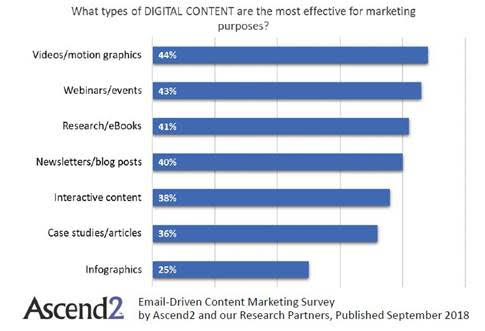
Videos or motion graphics are considered the most effective types of digital content used for marketing purposes by 44% of marketing professionals. Nearly as effective are webinars or events, and research or eBooks for 43% and 41% of marketing professionals respectively.

digital content types

Creating high-quality content is difficult, so when you create an awesome piece, make sure to optimize your results by generating a variety of content types. For example, a research study could produce the following content types:

  • Report: Create a report that is easy to scan and helps the reader answer questions that are important to them. 
  • Video: Many people would rather watch a video than read a report. So give them what they want with a video format of your research.
  • Webinar: Your research is an ideal tool to set the stage for the topic of your webinar. Use your research to identify a problem or opportunity and your speakers can provide expert advice on that topic. 
  • Blog posts: A quick review of a research chart will inspire a blog post. If you have eight research charts, that is eight blog posts.
  • Infographic: A picture is worth a thousand words. Use your research to tell a story visually. 

You do the math:

1 research study = 1 report + 1 video + 1 webinar + 8 blog posts + 1 infographic

Good News! Marketing Professionals are Achieving Priorities

More than half (54%) of marketing professionals consider an email-driven content marketing strategy to be very successful at achieving priorities. So keep combining email and content marketing–it is a great combination!

success of email driven content program

You can review the entire for guidance on creating your email and content marketing strategy. 

How to Add a Facebook Virtual Event to Your Launch Strategy

Do you host online events, webinars, or product launches? Wondering how to incorporate Facebook events into your marketing strategy? In this article, you’ll discover how to create and host a virtual Facebook event. Why Host a Virtual Facebook Event? A virtual Facebook event allows you to actively engage Facebook users without having (or in addition

Monday, September 17, 2018

Study Finds 83% of Americans Are Likely to Buy a Product or Service When This Happens

83. It’s the atomic number of Bismuth (yup, that’s a real element). It’s a prime number that is also the sum of five consecutive prime numbers (11 + 13 + 17 + 19 + 23). 83 is the title of a so-so John Mayer song.  

Interesting tidbits, right? 

Now the number 83 takes on new significance, at least for marketers. We’ve been working on some exciting brand-new research at Convince and Convert to better understand the importance and value of word-of-mouth marketing. Our newly-released report, Chatter Matters, found that on the whole, word-of-mouth is more powerful than has been previously documented. That’s where the number 83 comes in. According to Chatter Matters, 83% of Americans are more interested in purchasing a product or service when they’ve received a verbal recommendation from a friend or family member. 

83% of Americans are more interested in purchasing a product or service when they’ve received a verbal recommendation from a friend or family member. #ChatterMatters
Click To Tweet

Let that sink in: 83% of us are influenced by what our friends and family tell us because we trust them. Not only is word-of-mouth a powerful motivator, but it’s actually the way we prefer to get information when making purchase decisions. Among all Americans aged 13 and older, word-of-mouth represents two of our three most popular sources of information. The third? Online research, which in many instances like ratings and reviews is another form of word-of-mouth. 

Among all Americans aged 13 or older, word-of-mouth represents two of our three most popular sources of information. #ChatterMatters
Click To Tweet

more likely to buy statistic

When It Comes to Word-of-Mouth, Being Good Isn’t Enough

All marketers care about word-of-mouth—online and offline. It is the oldest form of customer acquisition and perhaps the most cost-effective. We mistakenly assume word-of-mouth will take care of itself and that our customers will talk about us. 

But we rarely give them a strong narrative hook to do so. Instead, we assume that being good gets us a story. 

We assume if we have good food, we’ll get a good story. 

We assume if we have good customer service, we’ll get a good story. 

We assume if we’re a good company, we’ll get a good story. 

Most people don’t tell each other about their perfectly adequate experiences with businesses. They tell them about the experiences that are memorable, interesting or outstanding. That’s the tipping point for word-of-mouth: It’s about creating an experience that is actually worth talking about. 

Consider Uber Conference, a cloud-based conferencing system. For those of you who haven’t used Uber Conference, they have terrific hold music you get to listen to during those inevitable minutes spent waiting for everyone to attend your meeting. At first, the music seems catchy enough, but then when you listen to the lyrics, you realize it’s unique and truly original. (You can listen to the hold music here.)

The song was written by Uber Conference’s co-founder and creative director, Alex Cornell. I’m not saying the song is Grammy worthy (although it’s very good), but it has been worthy of a lot of online conversation. It is a narrative hook people can use to talk about Uber Conference, and that’s exactly what happens.

The hold music on an @uberconference before anyone else joins is hysterically funny! 😂

— Caleb Whitmore (@calebwhitmore) June 2, 2018

Old is New Again, But This Time It’s Nuanced

Word-of-mouth seems simple enough, but it is as nuanced as any marketing discipline. In Chatter Matters, we saw variances in its importance across age (spoiler alert: Millennials really value word-of-mouth), gender (women respond to offline word-of-mouth more than men) and ethnicity (Caucasians are more influenced by word-of-mouth than non-Caucasians). 

When forced to select just one source of information to rely upon when making purchases, half of Americans would select online or offline word-of-mouth. 

So, there you have it. I hope you’ll take the time to read the entire Chatter Matters report and to seriously think about how you can take advantage of the fact that 83% of us are influenced by our friends and family’s recommendations. Watch out Bismuth. 83 just took on a whole new meaning. 

Chatter Matters is a proprietary word-of-mouth report produced by Convince & Convert Consulting and the research firm, Audience Audit. It examines the word-of-mouth attitudes of 1,001 randomly selected Americans. The margin of error is approximately +/- 3.1%. Chatter Matters is a companion piece to the new book, Talk Triggers: The Complete Guide to Creating Customers with Word-of-Mouth. Talk Triggers was co-authored by Jay Baer and Daniel Lemin. It will be released by Penguin Portfolio on October 3. 

How to Create Successful Videos for YouTube

How to Create Successful Videos for YouTube

I love to help brands be successful on YouTube. YouTube is the hardest of all the social media platforms to win at. Most brands are just throwing videos at YouTube hoping it will work. There are experts out there who say you just need content.

How many times have you heard someone say content is king? Well, I have bad news for you. The king is dead. The viewer is now the king and if you don’t make a video that people want to watch, they won’t.

What killed the old king? It was too much content to much noise. It was content that wasn’t valuable. It was content that didn’t have a plan beyond the idea that we just need content. It was also my favorite type of bad content: vanity content. Vanity content says, “We need a video because the CEO says we do.”

Everything you do on for marketing including YouTube needs to have a plan for how it will drive business.