Wednesday, January 2, 2019

Pressure Washing Services Princeton Kentucky | 270-201-7930 | Southern Power Wash

Pressure Washing Services Princeton Kentucky | 270-201-7930 | Southern Power Wash
http://bit.ly/2Rv81jc Southern Power Wash 3350 Highway 293 N Princeton, KY 42445 Power Washing Company Pressure Washing Company Residential Pressure Washing Residential Soft Washing Roof Washing Concrete Cleaning House Washing Commercial Pressure Washing Driveway Cleaning Graffiti Removal Parking Garage Cleaning Parking Lot Cleaning PRESSURE WASHING IN PRINCETON KENTUCKY. We believe every customer deserves our best. We promise to restore your residential or commercial property to it’s original luster by applying the latest hot water pressure washing in Princeton Kentucky, and soft washing technology in the industry. We are professional, well trained, fully insured, affordable, environmentally conscious, and always safe so you can rest assured that the job will be done right the first time. We’ve got you covered. Let our experts give you a free estimate today. Just look at these results! When you own property, you need to keep up with regular maintenance to make sure that it looks the best it can. At Southern Power Wash, we can help you to take care of all of your residential and commercial power washing needs. We offer quality power washing, pressure cleaning and exterior property restoration services that will help your home or business look like new by eliminating dirty driveways, clogged gutters and grimy siding. Southern Power Wash is the ideal solution for your Princeton property. We carefully select and train our teams of highly trained service providers. They will use the highest quality products and pressure washing technology to restore your home or office. Our process is adaptable to both commercial and residential needs and we include environmentally-sensitive biodegradable detergents to preserve your landscaping and nearby water resources. With innovative truck mounted and hand wheeled pressure washing units, we can service everything from a sprawling mall parking lot to a small patio space. You will be astounded at the sparkling results. Best Pressure Washing Services In The Princeton Kentucky Area Best Pressure Washing Services In The Princeton Kentucky Area Best Pressure Washing Services In The Princeton Kentucky Area Best Pressure Washing Services In The Princeton Kentucky Area

How Gen Z Uses Word of Mouth [11 Statistics]

11 Gen Z Statistics on Word of Mouth

Gen Z (ages 13 to 22, as of 2018) is the first truly wired generation.

Constant connectivity to their friends and a multitude of information sources give this demographic group an extraordinary array of options when making choices.

Word of mouth is a key driver of buying among all generations. In fact, 50% of all Americans say they would choose word of mouth if they had to pick just one source of purchase information.

However, research reports from our team at Convince & Convert Consulting and from the Center for Generational Kinetics find that word of mouth is even more powerful when Gen Z decides what to buy.

Note that we help companies create new customers with word of mouth. The Center for Generational Kinetics helps companies capitalize on the business ramifications of generational differences.

Drawn from Chatter Matters: the 2018 Word of Mouth Report and The State of Gen Z 2018, here are 11 new Gen Z statistics that demonstrate how vital word of mouth is to this emerging generation.

48% of Gen Z has made a second-person word of mouth recommendation

“Second-person” word of mouth is when an individual makes a recommendation not because of their personal experience, but because a friend or family member told them something positive about the product, service, brand, or company.

48% of Gen Z has made such a recommendation, compared to 41% of Millennials, and 38% of Gen X and Boomers.

48% of Gen Z has made a second-person word of mouth recommendation
Click To Tweet
30% of Gen Z has made an overheard word-of-mouth recommendation

“Overheard” word of mouth is when an individual makes a recommendation not because of their personal experience, but because they were listening when someone they didn’t know praised the product, service, brand, or company.

30% of Gen Z has made such a recommendation, compared to 23% of Millennials, 16% of Gen X, and 13% of Boomers.

30% of Gen Z has made an overheard word-of-mouth recommendation
Click To Tweet
86% of Gen Z reads reviews before making a first-time purchase

Reviews are increasingly important for all buyers, but Gen Z consults online opinions extensively, and more so than any other generation.

86% of Gen Z reads reviews before making a first-time purchase
Click To Tweet
68% of Gen Z reads 3 or more reviews before making a first-time purchase

Gen Z is not satisfied glancing at one review and making a buy.

68% of Gen Z reads 3 or more reviews before making a first-time purchase
Click To Tweet
21% of Gen Z females read 9 or more reviews before making a first-time purchase

This embrace of reviews is made even more interesting considering that 11% of Gen Z males read 9 or more reviews before making a first-time buy.

21% of Gen Z females read 9 or more reviews before making a first-time purchase
Click To Tweet
Gen Z + Millennials are 99% more likely to rely on online reviews and social media when choosing a restaurant

These younger diners almost never make a restaurant selection without checking reviews and social media chatter. Compared to Gen X + Boomers, the Gen Z + Millennial cohorts are 99% more likely to use those sources of information.

Gen Z + Millennials are 99% more likely to rely on online reviews and social media when choosing a restaurant
Click To Tweet
Instagram is most popular way for Gen Z to follow brands

Among Gen Z, 41% follow brands on Instagram, with a smaller percentage checking in on companies via Twitter and elsewhere.

Instagram is most popular way for Gen Z to follow brands
Click To Tweet
52% of Gen Z brand followers are connected to at least 3 brands on Instagram

Among members of Gen Z who do follow brands on Instagram, 52% of them follow at least three.

52% of Gen Z brand followers are connected to at least 3 brands on Instagram
Click To Tweet
Gen Z females more likely to follow brands on Instagram

48% of Gen Z women follow brands on Instagram, compared to 36% of Gen Z males.

Gen Z females more likely to follow brands on Instagram
Click To Tweet
46% of Gen Z follows more than 10 influencers in social media

Gen Z trusts each other, and they trust influencers in their generation who have disproportionate audience, expertise, or experience. Nearly half of Gen Z follows more than 10 influencers in social media today.

46% of Gen Z follows more than 10 influencers in social media
Click To Tweet
Gen Z trust YouTube ads more than any other type of ad

This includes radio, print, television, social media ads, and beyond. YouTube ads — often featuring influencers — are the most trusted form of advertising among Gen Z.

Gen Z trust YouTube ads more than any other type of ad
Click To Tweet

These statistics and other research on Gen Z show that this generation is not simply a continuation of Millennials. Behaviors are different. Expectations are different. Attitudes are different. And use and embrace of word of mouth are different.

Fundamentally, Gen Z — at least at this time — relies more on word of mouth, in both its offline and online forms, more than any other generation.

Consequently, if your company sells to young consumers, you simply MUST have a successful word of mouth strategy. If you don’t, perhaps we can help?

The post How Gen Z Uses Word of Mouth [11 Statistics] appeared first on Convince and Convert: Social Media Consulting and Content Marketing Consulting.

10+ Marketing Predictions for 2019 From Top Marketers

Are you wondering what some of the brightest minds in marketing think about the future of the industry? Concerned about how marketing will change this year? Find out what Seth Godin, Mitch Joel, Mari Smith, Michael Stelzner, and other top marketers see on the near horizon. #1: Smart Audio Requires Integration From a purely data-driven

The post 10+ Marketing Predictions for 2019 From Top Marketers appeared first on Social Media Marketing | Social Media Examiner.

How to Research, Monitor, and Optimize for Questions

Posted by AnnSmarty

Have you been optimizing your content for questions? There are a few powerful reasons for you to start doing it now:

  • Niche question research is the most powerful content inspiration source
  • Questions are highly engaging: Asking a question triggers a natural answering reflex in human beings. Using questions on your landing pages and / or social media will improve engagement
  • Questions are very useful for niche and audience research: What can't people figure out in your industry and how can you best help them?
  • Question research allows you to understand natural language better and optimize for voice search
  • Question optimization allows for increased organic search visibility through both featured snippets and Google's "People Also Ask" results.

Just to reinforce the latter point, Google is going a bit insane with understanding and featuring questions in SERPs. Here's just one of their recent experiments showing a multifaceted featured snippet, addressing a possible follow-up question (courtesy of Barry Schwartz):

multifaceted featured snippets

Types of niche questions and how to group them
  • Basic questions (these usually relate to defining concepts). In most cases you don't need to write lengthy explanations because people searching for those seek quick easy-to-understand answers.
  • How-to questions (these usually relate to step-by-step instructions). Adding videos to better explain the process is almost always a good idea here
  • Branded questions (those usually include your or your competitor's brand name or a product name). Like any branded queries**, these should be further categorized into:
  • ROPO questions ("research online, buy online / offline"). These are specific questions discussing your product, its pros and cons, reviews, etc.
    • High-intent questions: for example, questions asking how to buy your product.
    • Navigational questions: those addressing your site navigation, e.g. "How to login," "How to cancel," etc.
    • Competitive research questions: those comparing your brand to your competitors.
    • Reputational questions: those questions relating to your brand history, culture, etc.

Type of Questions

All branded questions may also be labeled based on possible sentiment.

** Most basic and how-to questions are going to have informational intent (simply due to the essence of the question format: most people asking questions seek to find an answer, i.e. information). But there's always a chance there's a transactional intent there that you may want to make note of, too.

For example, "What's the best CRM" may be a query reflecting a solid commercial intent. Same goes about "How do you use a CRM?" Both can be asked by someone who is willing to give the software a try, and this needs to be reflected within your copy and on-page layout.

Tools to discover questions1. People Also Ask

"People Also Ask" is a newer Google search element containing related questions to a given query. It's not clear how Google is generating these (it might be due to enough people typing each question into the search box), but what we do know for sure is:

  • Google is smart: It would only show things to a user when they have found enough evidence that's helpful and something their users engage with
  • "People Also Ask" boxes present more SERPs real estate which we may want to dominate for maximum organic search visibility

People Also Ask

With that in mind, People Also Ask results are important for content marketers on two fronts:

  • They allow us lots of insight into what our target audience wants to know
  • They allow us additional organic search visibility

To collect as many People Also Ask results as you can, give Featured Snippet Tool a try (disclaimer: This tool has been developed by the company I work for). It checks your domain's important search queries and generates "People Also Ask" results for all of them:

People Also Ask results

The tool ranks "People Also Ask" questions by the number of queries they were triggered by. This enables you to quickly see most popular questions on your topic.

2. Google / Bing SERPs

Search results give us lots of cues beyond People Also Ask boxes, provided you use smart tools to analyze them. Text Optimizer is a tool that extracts terms and concepts from SERPs and uses semantic analysis to come up with the list of questions you may want to include in your content:

I believe that is partly what Google is doing to generate those “People Also Ask” suggestions, but this tool will give you more ideas than “People Also Ask” boxes alone.

It supports Google and Bing. You can also copy-paste your text in the tool and it will suggest terms and questions to add to optimize your content better for either search engine.

3. Google Suggest

Google Suggest is another search-based tool for content marketers. Google Suggest auto-completes a user's query based on how other users tend to complete it. This way, we can safely assume that all Google Suggest results have a solid search volume / demand, simply because they ended up in the suggest index.

The problem with this one is that you need to know how to start typing the question to see it properly completed:

Google Suggest

There's a workaround that forces Google to autocomplete the middle of the query:

  • Type your core query and hit search
  • Put your cursor back at the beginning of the query
  • Type "how" and Google will suggest more popular queries:

Google Suggest middle of the query

Another way to discover more question-type Google Suggest results is to play with the following tools:

Serpstat Questions is a solid keyword research tool allowing you to generate hundreds of niche questions based on your core query. What's helpful is that Serpstat allows you to sort results by the question word:

Serpstat Questions

...and filter questions by a popular term in the tag cloud, making it easier to make sense of those multiple results (and optimize for several questions within one content asset):

Serpstat questions filter

Ahrefs is another multi-feature SEO platform that allows users to research related questions with one of its recent updates:

Ahrefs questions

If you end up with too many Google-suggested questions, run your list through Serpstat’s clustering tool to break those questions into meaningful groups based on relevancy.

Tuesday, January 1, 2019

How to Get Your Sales Team to Use Social Media: A 6-Step Plan

Do you want your sales team to support your social media outreach? Looking for a guide to ease the transition? In this article, you’ll find a six-step plan to help your sales team adopt social media in their daily routine. Why Your Sales Team Should Use Social Media Plain and simple, I define social selling

The post How to Get Your Sales Team to Use Social Media: A 6-Step Plan appeared first on Social Media Marketing | Social Media Examiner.

Monday, December 31, 2018

How to Plan a Social Media Collaboration

Looking for an exciting way to reach a specialized audience? Have you considered a social media campaign collaboration? In this article, you’ll discover how to partner with another brand to promote products and services to your respective audiences. Why Run Joint Social Media Campaigns? The pace and competitiveness of social media marketing often narrow our

The post How to Plan a Social Media Collaboration appeared first on Social Media Marketing | Social Media Examiner.

Friday, December 28, 2018

How Keyword Intent Can Boost Your Conversion Rate

What is keyword intent?

What is Keyword Intent?

Keyword intent represents the user’s purpose for the search. It’s what the user is likely to do when searching for a particular phrase. Or, to be more precise, it’s what we think the user is likely to do since we cannot always be sure.

Keyword intent is undoubtedly the most important concept when it comes to keyword research. It helps you meet the users’ needs better and match your content and landing pages to their intentions. Analyzing keywords by intent is thus your first step when diagnosing conversion issues when it comes to search referrals.

Analyzing keywords by intent should be your first step when diagnosing conversion issues.
Click To Tweet
The 4 Types of Keyword Intent

There are four types of keyword intent:

  1.  Commercial “high intent” intent
  2.  Informational intent
  3.  Transactional intent
  4.  Navigational intent

Let’s quickly see what each of these means.

1. Commercial, or High, Intent

This type can also be referred to as “buy now” intent. It signifies a strong intention on the part of the searcher to act (to buy, join, subscribe, etc.). Usually, these will be keyword phrases containing the following modifiers:

  •  Buy (online)
  •  Coupon (code)
  •  Deals
  •  Free shipping, etc.

People are most likely to commit to purchase as a result of these types of searches.

2. Informational Intent

Informational intent, on the other hand, means that the searcher is willing to find out more about the concept. It’s probably not a good idea to try selling anything to them outright, but these could be good for developing “gated” content and collecting emails. Queries with purely informational intent could contain the following modifiers:

  • How to . . .
  • Why . . .
  • Best way to . . .
  • History of . . .
  • Anatomy of . . .
  • What . . . means
3. Transactional Intent

Transactional intent lies somewhere in the middle of commercial and informational intent. Simply put, these queries can represent both the purpose to buy and to read more about the concept. With the right content and setup, these searchers may buy things or be convinced to buy somewhere further into the conversion funnel. These queries can contain words like:

  • . . . Reviews
  • . . . vs . . .
  • Best . . .
  • Top 10 . . .
4. Navigational Intent

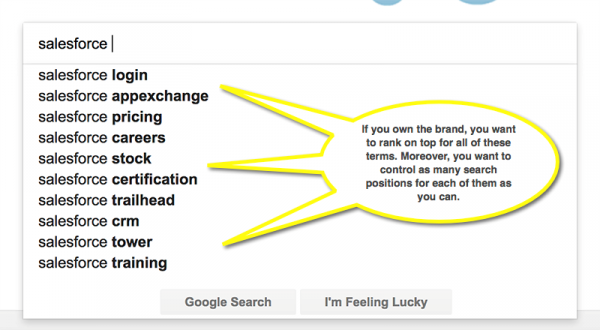
Keywords that contain brand names signal navigational intent, meaning a searcher knows exactly where they’re headed. Brand name searches are your assets. If a person types in your brand name when searching, they already know exactly what they want; you just need to give that to them.
Navigational intent

What you need to do here is to make sure:

  • Those searchers will land on your site, so your assets rank in top three for those queries.
  • Your website will satisfy their need in the best possible way: The landing page will offer them all the answers and/or let them perform the intended action

Pay close attention to search queries that contain your brand name, and monitor your site rankings for all of them.

How to Identify Keyword Intent

In most cases, you’ll be able to use your common sense when determining the search query intent. In many cases, it’s pretty obvious whether a user intends to buy, research, or navigate to a particular website.

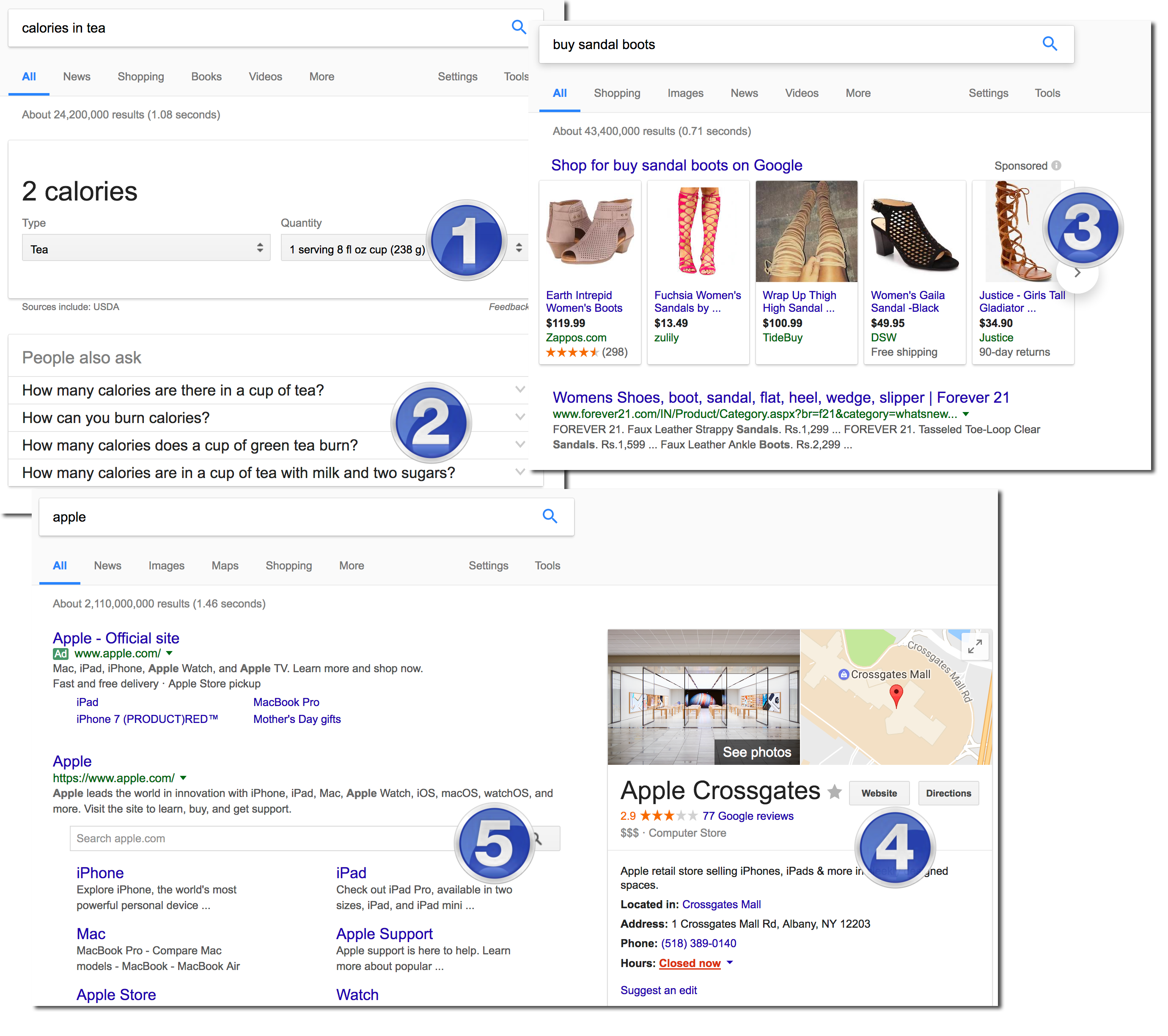
Google has been working on identifying user search intent in the best possible way for at least a decade now, so you’ll be able to pick up some cues by simply searching Google. Namely, Google’s so-called “Universal” search is the search giant’s attempt to meet the searcher’s needs and give them what they need right within the search results. In most cases, these types of search results will signal the user’s intent (as Google perceives it):

  1. “Quick-answer” search boxes (those giving you a short answer on top of search results) signal information intent.
  2. “People Also Ask” boxes also signal informational intent.
  3. Google’s shopping results signal “high-intent” search queries.
  4. Google’s local results and knowledge graph tend to signal navigational queries.
  5. So does the “Search in Search” feature.
Google search intent

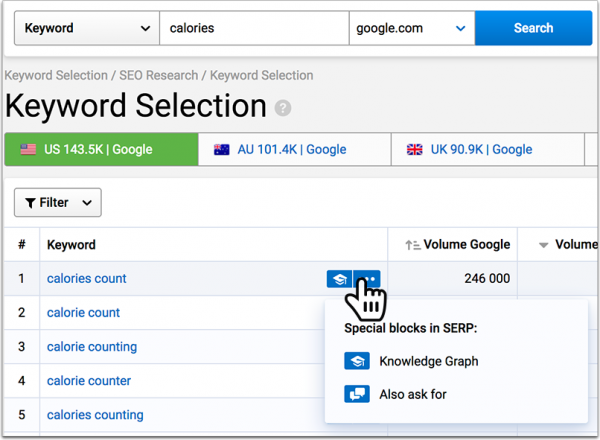
You can use Serpstat to see which types of “universal” search results from any given query triggers:
Serpstat

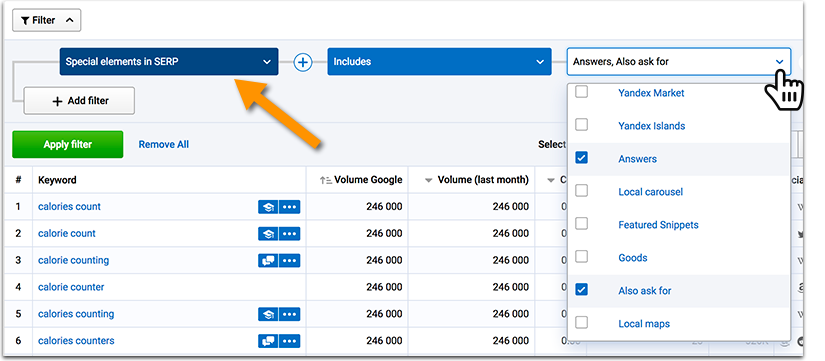
You can also use Serpstat filters to restrict your search to queries triggering a particular search type (and hence a particular intent):
Serpstat

This is a very useful trick when you are working on a specific marketing strategy. For example, when creating an editorial calendar, you can use Serpstat to research keywords triggering “People also ask” results, revealing obvious informational intent.

How to Organize Keywords for Better Conversions

Being an integral part of keyword research, intent helps you create a more organized content strategy aiming at happier customers and better conversions. The first step is to organize keyword phrases by intent:

  • Keywords with informational intent are straightforward content ideas to send to your content development team.
  • Keywords with transactional intent, which could include content ideas (product lists, product comparison, product FAQ, product manuals, etc.) that smoothly walk the reader down the conversion channel.
  • Keywords with commercial intent: If you have a product to match, refer to your SEO team to figure out how to better optimize product pages for them to rank for these queries. Alternatively, these can be product bundles (product lists) or other types of “buy now” landing pages that could match the exact high intent query.
  • Keywords with navigational intent may be further organized by intent: Some of these queries will have “buy now” intent, while others may signal transactional intent (e.g. potential customers researching your product reviews). Some of these should be sent to your reputation management team, while some of these will help your sales or customer teams to better meet your clients’ expectations. Most of these queries will be useful for more than one team.

Next, organize your keyword lists further by a required action:

  • Some keywords may be good ideas for new content or new landing pages.
  • Some keywords may be used to optimize or update old pages.

Finally, organize those keywords by landing page type. Informational and transactional queries may call for different types of content and landing page to better satisfy the users’ needs. For example, you can decide to create:

  • Blog posts (lists of products for an upcoming holiday, gift ideas, etc.)
  • FAQ pages (especially if these are navigational queries)
  • On-site glossaries (if you are in an industry full of complicated terms)
  • Various types of cornerstone content (also referred to as “content upgrades”)

You can use Excel or Google Spreadsheets to organize your keywords using multiple labels. You can go through your keyword lists and organize them by intent, required action, and the type of the landing page you plan to create.
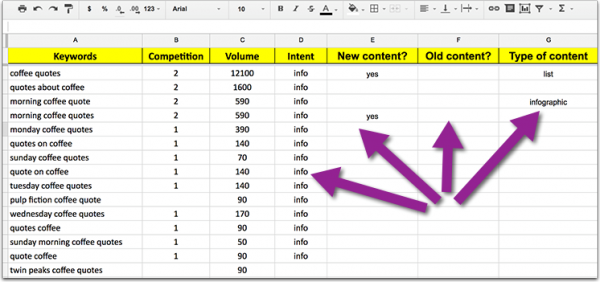
Using spreadsheets for keyword organization

View and copy this template here.

You can then integrate those spreadsheets into a marketing dashboard or project management platform like Cyfe or Trello (or any of these other options) for easier sharing.
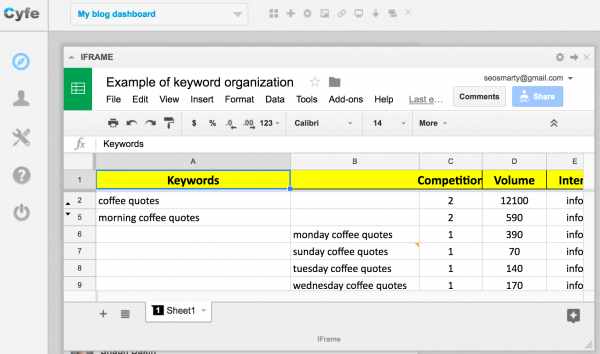
Integrating keyword research with project management platform

Working with keywords takes time, but it defines your future marketing strategy on many levels, so don’t rush things up! Targeting user intent when planning and optimizing your content makes your whole digital strategy much better organized and more conversion-oriented. With the above analysis, suddenly each of your web pages has a purpose.

The post How Keyword Intent Can Boost Your Conversion Rate appeared first on Convince and Convert: Social Media Consulting and Content Marketing Consulting.