Thursday, August 23, 2018

Useful Tools to Analyze Your Twitter Marketing and Content

When was the last time you analyzed your Twitter marketing? Looking for tools that can help you get a grip on your audience and Twitter content? In this article, you’ll learn how to analyze Twitter audience makeup and engagement data to deliver the types of content your audience values most. #1: Assess the Personality of

Wednesday, August 22, 2018

How to Use Social Data to Get the Edge on Competitors

Your brand is in a constant fight against competitors.

You have to know how you’re perceived. Where you’re losing. What your competitors excel at. And where they’re weak.

Unfortunately, most brands don’t prioritize this data. They either don’t collect it because they don’t know what to look for, or they don’t have the right tools to measure it.

Working with our friends at Brandwatch, I set out to help solve this problem in a Webinar on effective competitive intelligence using social media data.

Phillip Agnew, Product Marketer at Brandwatch, joined me for this session, where we presented a five-stage checklist to help you figure out how you’re performing.

You can get the entire session—at no cost—on demand right now. Just visit this link.

Why You Should Keep Reading

Today, customer expectations are liquid, meaning that they slosh over from one business category to the next. It wasn’t that long ago that customers would say “that’s a pretty good experience, for a financial services company.” Or, “that’s a pretty good experience, for a B2B company.” No more. The best companies in the world are training YOUR customers what to expect, period. If they can make it one-click easy, offer free two-way shipping, be open 24 hours per day, and send hyper-relevant emails, why can’t you?

best companies set expectations

The genie of customer expectations is never going back in the bottle, and what was amazing in 2015 is “meh” today. You simply must continue to raise the bar. This is what I am constantly harping on our team about here at Convince & Convert: yesterday’s victories mean nearly nothing now. The scoreboard always resets to zero. How can you get better and better and better and better, without end?

Customer experience is an escalator, not stairs.

Your competitors—the smart ones at least—are thinking the exact same way. Your customers are overtly measuring what you deliver to what your competition delivers.

And to stay on top, you need to know exactly what the other guys are up to, which is where social media data becomes very valuable when you use it consistently and wisely.

Here’s a summary of 5 key points in the Webinar on how to use social data for competitor analysis.

1. Share of Voice

Compared to your competition, how many customers are talking about you?

2. Sentiment by Competitor

Within your competitive set, are consumers saying positive or negative things about each company? Who stands out? Who is the “favorite” of the consumer?

3. Key Topics by Competitor

This is where it gets insightful. Using social data, you can (and should) create maps about what topics competitors are posting about on social media. This helps to understand their product strategy, their marketing strategy, their sales strategy, their customer service strategy, their employee advocacy program, and a lot more.

Smart analysts use social data to be the cartographer of their business category.
Click To Tweet

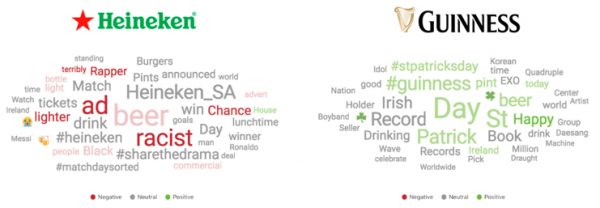
This example, supplied by Brandwatch, shows social media chatter about competitors Heineken, and Guinness. As you can see, the topics in this snapshot in time are very different, even though the products are quite similar.

social media chatter about Heineken and Guinness

Social media chatter about Heineken and Guinness

4. Benchmark by Product Type

Here, you use social media data to determine how often consumers are talking about your brand in the context of specific products. For example, in the Webinar, Phillip showed an example of Burger King tracking how much consumers talked about their new veggie burger, in comparison to vegetarian offerings from other fast food restaurants.

5. Benchmark by Product Association

I love this one. Here, you track how often specific, desirable attributes are associated with your brand (vs. competitors) by mining word inclusion in consumers’ social media posts.

adjectives associated with automotive brands

Adjectives associated with automotive brands

In this example, supplied by Brandwatch, you’ll notice that Mercedes-Benz dominates the conversation around “comfort”, while BMW has far more social chatter related to “luxury.”

If you’re trying to figure out your brand positioning, content marketing, social media marketing, and PR approach, this information can be incredibly valuable.

There are, of course, many more ways to use social data to gauge competitor behavior and attributes. But those are the five that we focused upon in our session.

I’d love it if you took the time to watch the replay. It’s a good one!

5 Tips to Ace Your Social Media Marketing Strategy

5 Tips to Ace Your Social Media Marketing Strategy

If you want to engage in social media, you need to have a social media strategy. If you want to engage in social media to market your company, you need to have a social media marketing strategy. Whether or not you have a formal social media marketing strategy written down or not, here are some tips to help make your social media engagement more strategic.

The Template for a Successful Social Media Marketing Strategy
1. Know your target audience

The first step towards creating a successful social media marketing strategy is knowing who your target audience is : determining who your product is meant for. How do you go about deciding who your product would appeal to?

Here are 3 things you should consider while making a decision :

  1. What your industry deals with : Before diving into who you should be targeting, you need to have a clear understanding of why your product or service exists.

How to Use Facebook and Twitter Ad Transparency Tools

Wondering what your competitors’ social media ads look like? Have you heard of the ad transparency tools for Facebook and Twitter? In this article, you’ll discover four ways social media marketers can use Facebook and Twitter ad transparency tools. Access the Ad Transparency Tools on Facebook and Twitter The ability for any user to see

Tuesday, August 21, 2018

Participate in Our Audience Survey and Win a Free Conference Pass

I’m new, and I want to learn more about YOU.

Jay tasked me with the job of doubling our blog traffic. ðŸ˜¬

Considering how popular the blog already is, this is no easy task.

But we don’t just want any traffic. We want quality traffic that turns into awesome clients and even better friends. So while I could simply turn on the listicle and how-to machine, and churn out new posts on every topic imaginable (statistics and tools posts, anyone?), we will be much more successful if we tailor our content to solving your problems and making your life better.

Here’s a little background on our content evolution:

A New Editorial Strategy for Convince & Convert: Phase 1

Last November, the awesome Kelly Santina and Jess Ostroff explained an updated C&C content strategy, with 5 posts per week. Traffic was dipping, and the goal was to increase new and returning visitors. Traffic steadily increased, but there was more work to be done.

Convince & Convert Weekly Editorial Calendar: November 2017

Content Strategy: Phase 2

While visitors and views are nice, they don’t mean a thing unless they turn into real relationships. So Jay, Jess, Kelly and the team refreshed the Convince & Convert content strategy again. Instead of posting 5 days per week, they reduced the number of weekly posts to 2 in order to allow our team to focus on improving the quality of original content and in-house research (check out our latest study on the Best University Websites for 2018).

The Consulting team backs up all client strategy with data and research, so our in-house content marketing strategy should reflect that, too.

As Jay explained in his post last month, we’re “we’re not in the how-to business, we’re in the ‘now what’ business.” While I seriously love a nice how-to post for generating views and organic search traffic, there are already a variety of amazing resources for that, including MarketingProfs (my personal fav) and Content Marketing Institute.

Our content strategy should reflect what is unique and valuable about our company. And a great place to start? The work we do with many of the world’s most interesting brands to solve large and thorny marketing and customer experience challenges. So we’re creating more content based on client questions and experiences, and more content featuring our own in-house, first party research.

Content Strategy: Phase 3

And now here I am, mapping out our content calendar for Q3 and beyond.

My goal is to double our blog traffic and the number of quality leads we bring in on a monthly basis.

I already know who our clients are, but now I need to know who you are, trusty reader.

Are you more in the weeds or more in the C-suite? Do you market B2B or B2C? Are you in manufacturing, education, tourism, or something else entirely?

So please, take a minute and fill out our 60-second survey. We will analyze the results, and turn those findings into topics for our editorial calendar, a more effective content strategy, and perhaps even, a monthly reader’s choice post where you, the reader, select the topic of one post per month.

If you include your email address, you will be entered to win a pass to Social Media Marketing World 2019 OR ConEx 2019—your choice! I’m sure we’ll be there too.

So take the audience survey now. I can’t wait to get to know you, and meet you IN person—if you are the lucky winner of the conference pass!

Winners will be notified on September 30.

How to Use Instagram Stories Stickers in Your Marketing

Wondering how to get more from Instagram Stories? Have you considered using Stories stickers in your marketing? In this article, you’ll discover how to use Instagram Stories stickers to deliver engaging and useful Stories content. Find Your Instagram Stories Stickers To access all of the different Instagram Stories stickers, start a story post with a photo

NEW On-Demand Crawl: Quick Insights for Sales, Prospecting, & Competitive Analysis

Posted by Dr-Pete

In June of 2017, Moz launched our entirely rebuilt Site Crawl, helping you dive deep into crawl issues and technical SEO problems, fix those issues in your Moz Pro Campaigns (tracked websites), and monitor weekly for new issues. Many times, though, you need quick insights outside of a Campaign context, whether you're analyzing a prospect site before a sales call or trying to assess the competition.

For years, Moz had a lab tool called Crawl Test. The bad news is that Crawl Test never made it to prime-time and suffered from some neglect. The good news is that I'm happy to announce the full launch (as of August 2018) of On-Demand Crawl, an entirely new crawl tool built on the engine that powers Site Crawl, but with a UI designed around quick insights for prospecting and competitive analysis.

While you don’t need a Campaign to run a crawl, you do need to be logged into your Moz Pro subscription. If you don’t have a subscription, you can sign-up for a free trial and give it a whirl.

How can you put On-Demand Crawl to work? Let's walk through a short example together.

All you need is a domain

Getting started is easy. From the "Moz Pro" menu, find "On-Demand Crawl" under "Research Tools":

Just enter a root domain or subdomain in the box at the top and click the blue button to kick off a crawl. While I don't want to pick on anyone, I've decided to use a real site. Our recent analysis of the August 1st Google update identified some sites that were hit hard, and I've picked one (lilluna.com) from that list.

Please note that Moz is not affiliated with Lil' Luna in any way. For the most part, it seems to be a decent site with reasonably good content. Let's pretend, just for this post, that you're looking to help this site out and determine if they'd be a good fit for your SEO services. You've got a call scheduled and need to spot-check for any major problems so that you can go into that call as informed as possible.

On-Demand Crawls aren't instantaneous (crawling is a big job), but they'll generally finish between a few minutes and an hour. We know these are time-sensitive situations. You'll soon receive an email that looks like this:

The email includes the number of URLs crawled (On-Demand will currently crawl up to 3,000 URLs), the total issues found, and a summary table of crawl issues by category. Click on the [View Report] link to dive into the full crawl data.

Assess critical issues quickly

We've designed On-Demand Crawl to assist your own human intelligence. You'll see some basic stats at the top, but then immediately move into a graph of your top issues by count. The graph only displays issues that occur at least once on your site – you can click "See More" to show all of the issues that On-Demand Crawl tracks (the top two bars have been truncated)...

Issues are also color-coded by category. Some items are warnings, and whether they matter depends a lot on context. Other issues, like "Critcal Errors" (in red) almost always demand attention. So, let's check out those 404 errors. Scroll down and you'll see a list of "Pages Crawled" with filters. You're going to select "4xx" in the "Status Codes" dropdown...

You can then pretty easily spot-check these URLs and find out that they do, in fact, seem to be returning 404 errors. Some appear to be legitimate content that has either internal or external links (or both). So, within a few minutes, you've already found something useful.

Let's look at those yellow "Meta Noindex" errors next. This is a tricky one, because you can't easily determine intent. An intentional Meta Noindex may be fine. An unintentional one (or hundreds of unintentional ones) could be blocking crawlers and causing serious harm. Here, you'll filter by issue type...

Like the top graph, issues appear in order of prevalence. You can also filter by all pages that have issues (any issues) or pages that have no issues. Here's a sample of what you get back (the full table also includes status code, issue count, and an option to view all issues)...

Notice the "?s=" common to all of these URLs. Clicking on a few, you can see that these are internal search pages. These URLs have no particular SEO value, and the Meta Noindex is likely intentional. Good technical SEO is also about avoiding false alarms because you lack internal knowledge of a site. On-Demand Crawl helps you semi-automate and summarize insights to put your human intelligence to work quickly.

Dive deeper with exports

Let's go back to those 404s. Ideally, you'd like to know where those URLs are showing up. We can't fit everything into one screen, but if you scroll up to the "All Issues" graph you'll see an "Export CSV" option...

The export will honor any filters set in the page list, so let's re-apply that "4xx" filter and pull the data. Your export should download almost immediately. The full export contains a wealth of information, but I've zeroed in on just what's critical for this particular case...

Now, you know not only what pages are missing, but exactly where they link from internally, and can easily pass along suggested fixes to the customer or prospect. Some of these turn out to be link-heavy pages that could probably benefit from some clean-up or updating (if newer recipes are a good fit).

Let's try another one. You've got 8 duplicate content errors. Potentially thin content could fit theories about the August 1st update, so this is worth digging into. If you filter by "Duplicate Content" issues, you'll see the following message...

The 8 duplicate issues actually represent 18 pages, and the table returns all 18 affected pages. In some cases, the duplicates will be obvious from the title and/or URL, but in this case there's a bit of mystery, so let's pull that export file. In this case, there's a column called "Duplicate Content Group," and sorting by it reveals something like the following (there's a lot more data in the original export file)...

I've renamed "Duplicate Content Group" to just "Group" and included the word count ("Words"), which could be useful for verifying true duplicates. Look at group #7 – it turns out that these "Weekly Menu Plan" pages are very image heavy and have a common block of text before any unique text. While not 100% duplicated, these otherwise valuable pages could easily look like thin content to Google and represent a broader problem.

Real insights in real-time

Not counting the time spent writing the blog post, running this crawl and diving in took less than an hour, and even that small amount of time spent uncovered more potential issues than what I could cover in this post. In less than an hour, you can walk into a client meeting or sales call with in-depth knowledge of any domain.

Keep in mind that many of these features also exist in our Site Crawl tool. If you're looking for long-term, campaign insights, use Site Crawl (if you just need to update your data, use our "Recrawl" feature). If you're looking for quick, one-time insights, check out On-Demand Crawl. Standard Pro users currently get 5 On-Demand Crawls per month (with limits increasing at higher tiers).

Your On-Demand Crawls are currently stored for 90 days. When you re-enter the feature, you'll see a table of all of your recent crawls (the image below has been truncated):

Click on any row to go back to see the crawl data for that domain. If you get the sale and decide to move forward, congratulations! You can port that domain directly into a Moz campaign.

We hope you'll try On-Demand Crawl out and let us know what you think. We'd love to hear your case studies, whether it's sales, competitive analysis, or just trying to solve the mysteries of a Google update.


Sign up for The Moz Top 10, a semimonthly mailer updating you on the top ten hottest pieces of SEO news, tips, and rad links uncovered by the Moz team. Think of it as your exclusive digest of stuff you don't have time to hunt down but want to read!